How structured resistance training supports strength, posture, and long-term resilience
By Erica Walters, Pilates Fit Studio Owner, Exercise Scientist, Certified Classical Pilates Teacher, Certified GYROTONIC® Method Teacher, Creator of The Better Back®: Spine & Bone Health
Strength training is one of the most beneficial things you can do for longevity. But if you have been diagnosed with osteopenia or osteoporosis, you have likely heard conflicting advice about what exercise is safe, what matters most, and whether you can actually improve strength over time.
Here is the truth.
Exercise matters. But the way you train matters more.
And the training principle that determines whether your workouts create change over time is called progressive overload.
Progressive overload is not a trend. It is the foundation of resistance training and one of the most important strategies we have for building strength, supporting posture, reducing fall risk, and training the body for the long game.
What Is Progressive Overload
Progressive overload means gradually and consistently increasing one or more training variables over time so your body has a reason to adapt. In real life, it looks like this: you train at a level where you can maintain excellent form, then you increase the challenge over time by adding resistance, increasing repetitions, or progressing to a harder variation. Progression only happens when your body can stay organized, controlled, and aligned.
Progressive overload can include increasing:
- Resistance or spring tension
- Repetitions
- Sets
- Frequency
- Range of motion
- Tempo and control
- Movement complexity
Progressive overload is what turns exercise into training. It builds strength, and as strength improves, your body becomes more stable, more capable, and more resilient.
Why Progressive Overload Matters for Bone Health
Bone is living tissue. It constantly remodels based on the signals it receives.
Two types of cells manage this process:
Osteoclasts break down old bones.
Osteoblasts rebuild and strengthen bone in response to load.
When bones experience safe resistance and appropriate loading, osteoblasts receive the signal that your body needs more support.
Bone responds to training the way muscle does — it adapts to what you ask of it.
This is why progressive overload matters. Without it, training becomes random. You may move, sweat, or feel good, but your body isn’t consistently receiving the signals it needs to build strength over time.
How Progressive Overload Works in Pilates and GYROTONIC®(With Real-Life Examples)
Progressive overload is not limited to barbells. It is a training principle that applies anywhere resistance exists.
In Classical Pilates, progressive overload is created through spring tension, bodyweight leverage, and structured sequencing.
In the GYROTONIC® Method, progressive overload is created through weight plates, pulley resistance, three-dimensional movement patterns, and increased range or control over time.
In both methods, the goal is the same: increase training demand over time while maintaining form, alignment, and control.
Here are two simple examples.
Example 1: GYROTONIC®Pulley Tower Resistance Progression
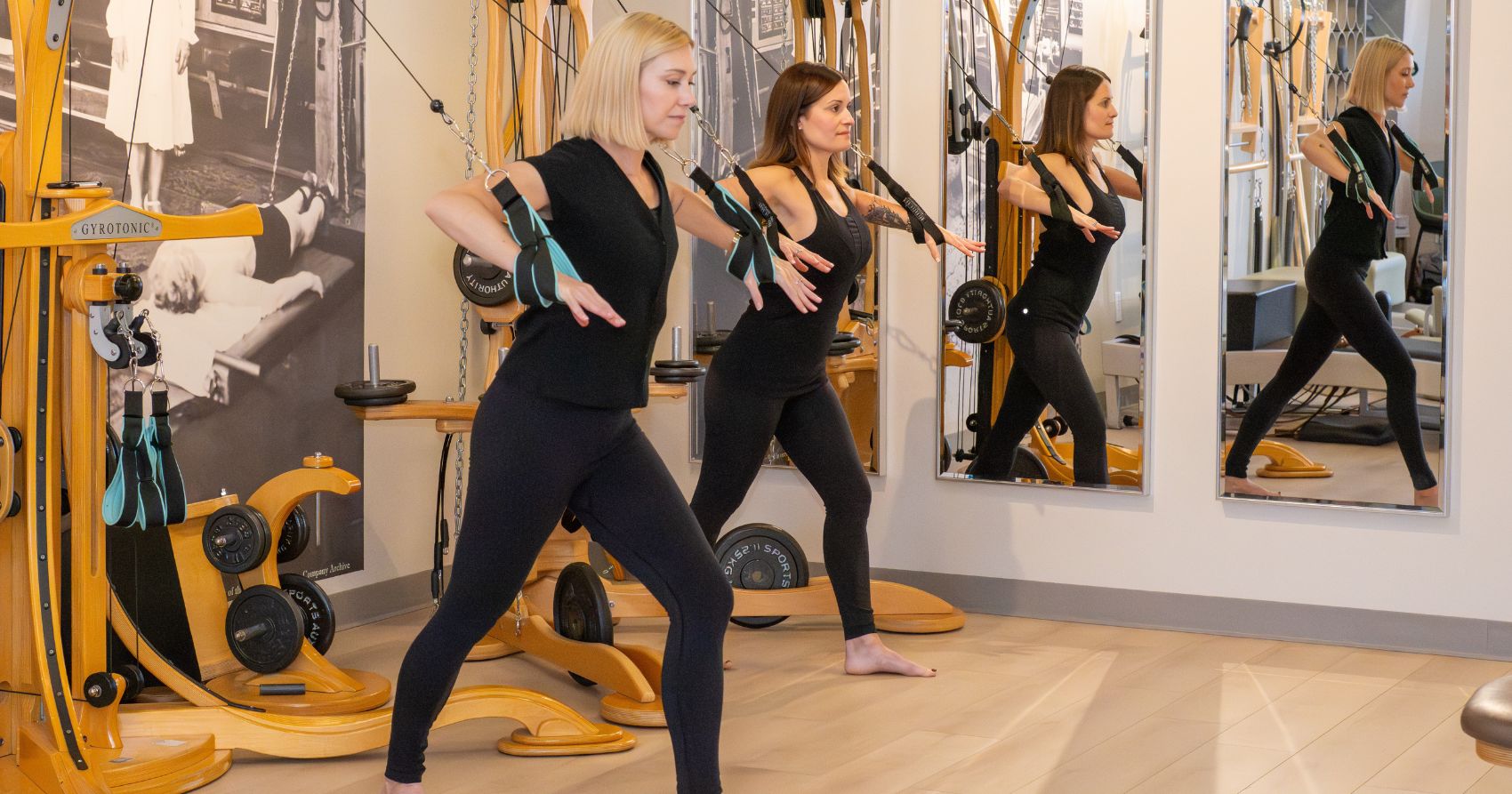
Let’s say you are using 15-pound weight plates on the pulley tower.
Right now, you can perform 7 strong reps with excellent posture, control, and alignment. But if you go past 7 reps, your form starts to break down. Maybe your spine shifts, your shoulders grip, or your ribs and pelvis lose organization.
That means 7 reps is your current training threshold.
Your progression looks like this:
- Stay at 15 pounds
- Build from 7 reps to 12 reps with clean form
- Then increase to 17.5 pounds
- Start back at 7 reps
- Progress to 12 reps again
That is progressive overload: strength increases without sacrificing form.
Example 2: Classical Pilates Wall Unit Spring and Repetition Progression
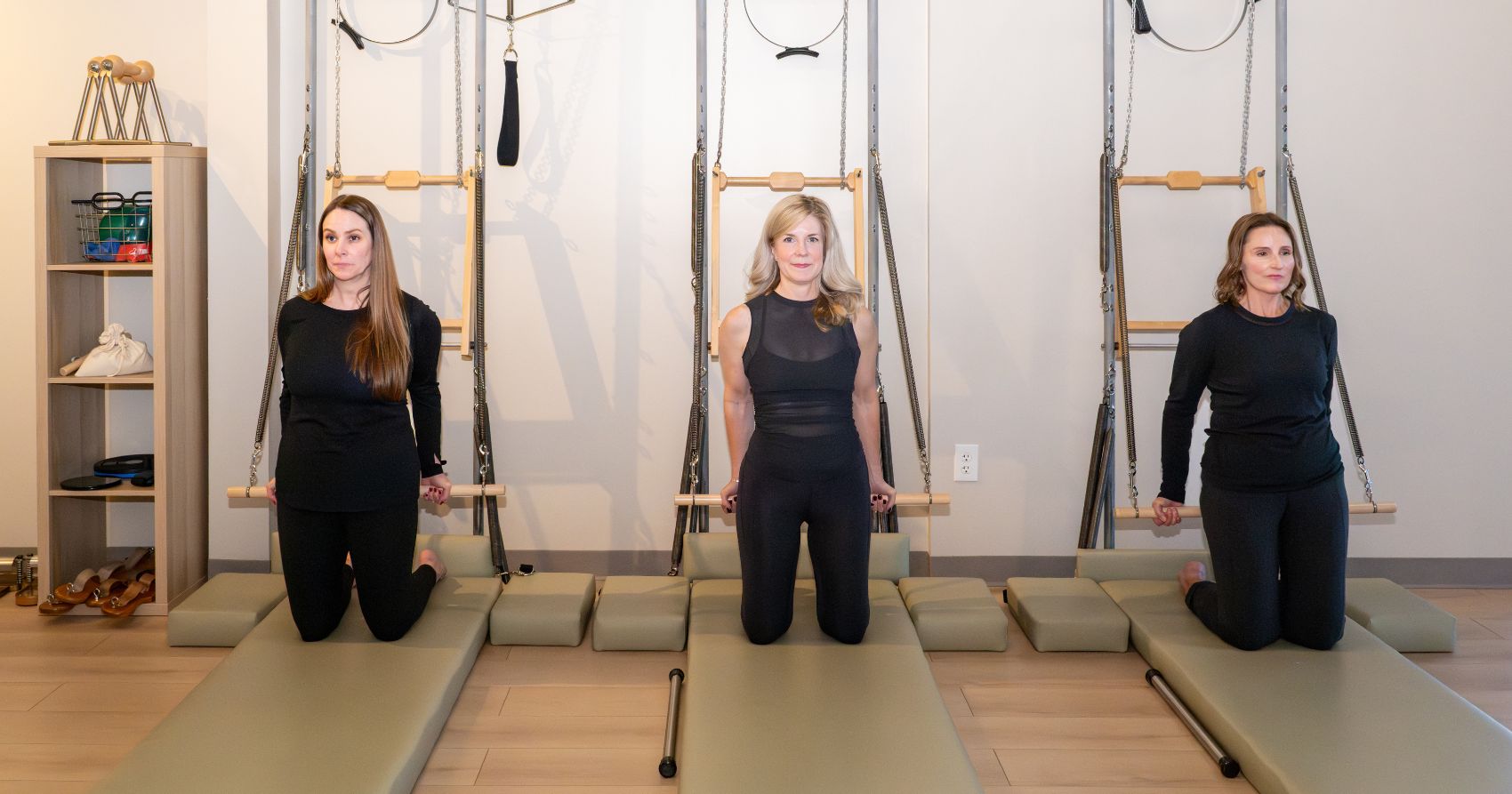
Progressive overload also applies in Classical Pilates through spring resistance and repetition progressions.
You may begin with standing arm springs and perform the full sequence with 4 reps of each exercise, maintaining posture and control.
As strength improves, you progress to:
- 6 reps
- then 8 reps
- then 10 reps of each exercise
Once you can complete the full sequence with 10 clean reps, you increase load by progressing from:
- arm springs
- to light leg springs
- then eventually, heavy leg springs
This is structured strength training using the same progressive principles as traditional resistance training — simply applied through springs and intelligent sequencing.
Progressive Overload Must Be Safe, Not Aggressive
Progressive overload does not mean pushing harder every week no matter what. For bone health, it means building strength gradually with excellent form, smart progression, and consistent training.
A Quick Note on Spine Safety
If osteoporosis is present in the spine, how you overload matters.
The goal is to build strength without adding compression through vulnerable spinal positions. That means avoiding resistance training patterns that load the spine while it is rounded or twisting under load.
Examples include:
- Loaded flexion (rounding forward under resistance)
- Twisting under load
- Twisting combined with flexion (rotation plus rounding)
This does not mean you stop training. It means progressive overload must be paired with intelligent programming: neutral-spine strength work, posture training, and controlled progression.
Progressive overload is the tool. Smart programming is how you use it.
Always consult your physician or provider for individualized medical guidance.
Why Generic Workouts Often Fail Osteoporosis Training
Many people are told to walk, do light weights, or “stay active,” but those recommendations often miss the most important piece:
Bone health training must be structured and site-specific.
The spine and hips are common areas of vulnerability, and a smart program must build strength and balance while respecting spinal mechanics and safety principles.
Osteoporosis-safe exercise cannot be random or trend-based. It must be strategic.
How Often Should Resistance Training Be Done
For most adults, resistance training is most effective when performed three to four times per week, depending on fitness history, recovery, and current goals.
Consistency matters because training requires repeated stimulus. Strength is built over time through repeated exposure and progressive challenge.
Resistance Training Is Not the Same as Physical Activity
Many people assume that walking and other forms of physical activity are enough to maintain strength. It is not.
Physical activity includes walking, cleaning, gardening, dancing, and daily movement that supports cardiovascular and pulmonary health.
Resistance training builds strength.
You need both.
Many adults benefit from building toward 10,000 to 15,000 steps per day, while also prioritizing structured resistance training throughout the week.
Nutrition Matters: Bone and Muscle Support
Exercise creates the stimulus, but nutrition supports the building process.
For long-term strength, posture, and resilience, nutrition should support:
- Protein intake to preserve lean muscle mass
- Calcium-rich foods to support bone structure
- Vitamin D and Vitamin K foods to support calcium pathways
- Nutrient-dense meals that support recovery and stable energy
Nutrition is not about extremes. It is about building a foundation that supports training and longevity.
The Bottom Line
If your goal is bone health, posture, and long-term resilience, progressive overload must be part of the plan.
It is the difference between random movement and structured training.
When progressive overload is applied safely and consistently, strength builds. Stability improves. Confidence grows. And your body becomes more resilient for the long game.
If you want to see how progressive overload is applied in a structured spine and bone health program, explore The Better Back®: Spine & Bone Health at Pilates Fit Studio.
Frequently Asked Questions: Progressive Overload and Bone Health
Is progressive overload safe for osteoporosis?
Progressive overload can be safe when applied strategically through appropriate loading, form coaching, and spine-safe movement strategies. It should be individualized and progressed gradually. Always consult your physician or provider for individualized medical guidance.
Can exercise really improve bone density?
Exercise can support improvements in bone density and strength when performed consistently and progressively over time. Bones respond to stress and load through remodeling. Exercise is not a short-term fix — it is a long-term strategy.
What is the best strength training for osteoporosis?
Many programs benefit from combining progressive resistance training, safe impact, balance training, and posture strengthening. A site-specific, structured approach is often most effective because osteoporosis is not uniform throughout the skeleton.
How quickly should I increase resistance?
Progression should be gradual and based on control, alignment, and recovery. If form breaks down, the load is too high. Strength training for longevity should prioritize quality, not speed.
Is walking enough for bone health?
Walking supports cardiovascular health and physical activity goals, but it does not replace resistance training. Strength training provides a stronger stimulus for maintaining muscle mass and building stability, which is key for fall prevention.
How many days per week should I strength train?
For most adults, three to four days per week is a strong goal for resistance training, depending on fitness history, recovery, and current needs.
GYROTONIC® and GYROTONIC EXPANSION SYSTEM® are registered trademarks of Gyrotonic Sales Corp and are used with their permission.